12 February 2016

Gravitational waves!

I never post on here except when my non-physicist friends ask me to explain something, and then I actually get the motivation to write it up. It's really funny that my last post, from over a year ago, was on the same topic. Now LIGO just released their results on a direct observation of gravitational waves!

On Fri, Feb 12, 2016 at 10:33 AM Gaetano Mina wrote:
Aggle please ELI5 the gravity physics discovery which is allegedly the biggest science deal of the decade.

Thanks. 
(For the record, ELI5 means "Explain like I'm 5")

My response:

It's only super awesome! They measured the signal from two black holes that were orbiting around each other until they merged. The NYT has a pretty good video that explains what's going on (the NYT data visualization people do amazing work in general) http://www.nytimes.com/2016/02/12/science/ligo-gravitational-waves-black-holes-einstein.html - I really love the way they explain how the interferometer works at 2:30


"Gravity waves" were something that was predicted a hundred years ago, and we've been looking for them ever since! The story of their prediction is kind of funny. Einstein came up with general relativity, but it was someone else who used it to predict that general relativity allowed "gravity waves" to exist. Einstein made some calculations and was all like "no you're wrong, waves are not possible" but he had made a mistake - and when he tried to publish this, the journal was like "bro u messed up" and he was like "no u" and got super pissed off and boycotted them for the rest of his life.

OK, so back to what's going on - If you swish your hand around in a circle in a pool of water, you'll make a spiral wave going out. This is basically what happens with the black holes that are orbiting each other, with the "water" in this case being spacetime itself. The wave itself is kind of weird - it's a compressed region of spacetime itself that's moving out from the orbiting black holes. You can sort of see what this looks like if you take a slinky and push it back and forth. This was the best video I found of that: https://www.youtube.com/watch?v=ubRlaCCQfDk
This is where the actual measurement gets even weirder - since it's spacetime itself that is changing shape, you can't measure changes with anything made of matter, because that changes size too. The only thing you can use is light, since the speed of light is always constant. This means they had to use a really, really long laser beam and measure the time it takes for the laser to return after bouncing off of a mirror. Since the speed of light is always the same, it isn't affected by the ripple in spacetime that's passing through the detector.
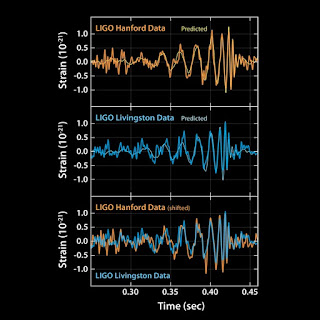
Next, these lasers are built here on Earth, and they're super sensitive, so they pick up movement like earthquakes, trees falling, and lots of other stuff that you don't care about, so somehow the LIGO people had to find a way to separate the gravitational wave signal from all this noise. They picked something that's really unique - the exact moment when the black holes spiral in faster and faster and faster and then merge. That's what they show in these plots here:
https://www.ligo.caltech.edu/image/ligo20160211a

It turns out that the frequencies are actually in the normal range of human hearing, so we can make a sound out of them! https://soundcloud.com/emily-lakdawalla/ligochirp  - this is the sound of two black holes merging. People are getting pretty excited about trying to chirp like LIGO.


So from 1.3 billion light years away, we caught the final moments of a black hole merger and confirmed a hundred-year-old consequence of general relativity that had never been seen before.

05 February 2015

No more gravitational waves :(

Back in March, BICEP2 made big news when they announced by press release that they had found gravitational waves left over from the Big Bang. This really made the rounds and gained a lot of interest from the popular press as well as the scientific press. At the time I was afraid that an internal review of the data wasn't enough, and that after all this noise they would just be wrong... and it turns out I was. This week they confirmed with PLANCK data that the signal comes from interstellar dust, and I was sad. The idea that the signal could be dust was first put forward really quickly after the initial press release, and as time went on it looked more and more likely to be true.

Today Nature published an editorial that strongly defended their enthusiastic reporting of the original BICEP2 results. They said, quite justifiably:
Nature has a stake in discussions of the gravitational-waves story. Our news team was among those tipped off about the claim in advance. We were proud of our (extensive) coverage, both in print and online, at the time. We remain so now. Like most other news organizations, we reported the claims from the provisional paper accurately and, like almost all the coverage, were sure to include the caveat that the findings would need to be confirmed. That is not to claim that the press can be given a free pass on this. Its job is to ask questions after all. But it is not always possible for journalists — even the best science writers — to provide the answers.

Then they aimed their sights at me, because I had been saying, mostly to friends, that BICEP2 should have waited at least for peer-review before making a big public announcement.
What about the promised lessons for scientists? As we have pointed out before, researchers must not be afraid to be wrong.
Their point was that even a peer-reviewed publication - something I had said should have been required before making a public announcement - isn't really ever the final word on science. More fundamentally, scientists must live with some level of uncertainty that what we think we know might turn out to be wrong, and we can't let that stop us from pushing forward.

I needed this reminder to think deeper than doing some easy armchair quarterbacking, and that I shouldn't be such a grump over people getting excited about new discoveries.

Fortunately the BICEP2 results are really just a sentence out of an ongoing conversation about finding these Big Bang remnants. Hopefully my buddies at CLASS can nail the discovery! And this poor guy can get his champagne back.

20 May 2014

We bought some art for the grad student lounge

The noble panda is the unofficial mascot of the Hopkins Department of Physics and Astronomy (P and A - panda); so when we saw panda-themed art on display in a local hangout we just had to put in an offer to buy it. Congrats, PandAs, we are now fancy art collectors! Here we are discussing the painting it in my office. On Friday we're going to unveil it at happy hour and hang it in the grad student lounge.


Well done, everyone!

15 May 2014

WSJ editorial on "the culture of privilege"

A relative of mine posted a WSJ article on my Facebook wall recently which sort of ticked me off. Since it's relatively rare that I manage to write out anything that isn't technical, I've put the article and my response below. The bulk of this post is going to be just the Facebook response, but I've added a little context on how it touches me personally:

The fields of physics and astronomy have a huge demographics problem, in that they are dominated by white men and have very few women and minorities, way out of proportion to the population of the US. For what it's worth, for these purposes I count myself as one of the white dudes -- growing up Cuban in Miami, especially as the son of two doctors, doesn't exactly put you at a disadvantage. Anyway, historically, a lot of this demographic bias was the result of conscious exclusion of everybody who wasn't white and male. Nowadays, while intentional exclusion is not nearly as bad (and fortunately illegal), its remnants hang around in the form of things like unconscious bias and the lack of women and minorities coming through the pipeline to enter the sciences. It's still easier for white guys to get to -- and through -- graduate school than for everyone else. This is our privilege, and we should be aware of it.

The article is here, and here's my response:

Harsh words:
>Perhaps, then, the ideology of "privilege" amounts to a pretense of egalitarianism, analogous to an ostentatious display of charity whose real motive is the philanthropist's self-aggrandizement. Elite universities are marketing themselves--to prospective students and to the broader society--as bastions of power and privilege. Humility can be a form of vanity, self-abnegation a means of status-seeking.

But even worse, we are asked this rhetorical question:
>If it's not about making individuals feel guilty, what is it about?

(To be 100% clear, the unspoken answer is that of course the ideology of privilege is only about making individual's feel guilty.)

It's a fair accusation, I guess, but it really misses the point of the conversation on "privilege". I like Alexandra Petri's amazing response to that incredibly obtuse editorial in Time Magazine that made the rounds recently:

>It seems that Tal may have mistaken the origin of this phrase, as though being told to Check Your Privilege meant “apologize for or explain away the advantages you’ve had” rather than “consider the perspective from which you come before you enter a conversation.”
(from )

What this writer – James Taranto – is missing is that Harvard is responding to the wishes of its students, as any good university should. It is emphatically NOT hypocritcal of Harvard to support its students in pursuing their interests, when it has admitted these students precisely because it believes their interests, and the perspectives from which they approach those interests, are valuable.

The central character of this article is Ms. Reetu Mody, the student who pushed for the class on privilege and structures of power. It is unclear to me if Mr. Taranto believes that the false humility belongs only to Harvard or extends to her as well. Why? Because he apparently couldn't be bothered to interview her for an article about something she did! We have no idea what her story is, and have no basis on which to judge her actions! Going by the article, it is clear that Mr. Taranto has simply assumed – without knowing anything about her – that her opinions should be tossed out by default.

What should Harvard do? Should Harvard simply dictate to its students what issues should matter, what issues are important enough for them to concern themselves with, and condescendingly tell them what issues are not? Fortunately, Harvard values the ideas and perspectives of its students more than Mr. Taranto does.
23 April 2014

The effects of drafting!

Here's a very cool video on how much benefit you get from drafting in cycling:


This really helps explain why riders on a break try so hard to get others to come with them. The most interesting part of the video, though, is how the rider still benefits even when someone is drafting off him. The drafting rider smooths the airflow, creating less turbulence and therefore less drag on the lead rider!

01 April 2014

CERN switches to Comic Sans

In the midst of all the press about how much money can be saved by changing fonts (see e.g. http://www.cnn.com/2014/03/27/living/student-money-saving-typeface-garamond-schools/), it's nice to see CERN getting on board by switching over to Comic Sans, effective today, April 1: http://home.web.cern.ch/about/updates/2014/04/cern-switch-comic-sans

22 March 2014

Updates, and I'm an astronomer now?

It's been a while since my last post, and a lot has changed!

First, I'm married! To the wonderful Katie Felkins, who is featured in some of the earliest posts here. We had a great time celebrating with our friends and family at the Maryland Zoo. It's hard to believe that was 8 months ago.

Second, I left high energy physics and joined the quest for Earth-like planets around other stars! For me, this is the most exciting field of science right now (and it's the fastest growing field of astronomy, so I'm not alone in thinking this). Recent advances in technology have finally made this possible on a large scale (see e.g. http://www.jpl.nasa.gov/news/news.php?release=2014-062). My data comes from Project 1640, whose goal is to blot out as much of the light from the host star as possible so that we can see the faint planets nearby. Aaaand I now have a research website! www.pha.jhu.edu/~jaguilar

Last, I am going to try focusing on shorter, less content-heavy posts to try to lower the activation barrier for writing here. We'll see how that goes.